

Frequency healing uses sound, light, or magnetic vibrations at set frequencies for relaxation; UCLA Health calls the research on sound therapy inconclusive but growing.
Frequency healing is a wellness practice that uses sound, light, or magnetic vibrations at set frequencies to support relaxation and balance. Practitioners also call it vibrational healing or sound healing. UCLA Health says research on sound therapy is inconclusive but growing, and early studies were small. A 2025 review found only 19 clinical studies on singing bowls, one of its main tools.
Key Takeaways
- Frequency healing uses tones, vibration, light, or pulsed magnetic fields measured in hertz (Hz) for relaxation and well-being.
- Common tools include singing bowls, tuning forks, the human voice, recorded tones, binaural beats, and vibroacoustic chairs.
- Small studies report lower tension and stress after sound sessions, but UCLA Health calls the research inconclusive.
- Cedars-Sinai says little scientific evidence supports claims about single "healing frequencies" such as 432 Hz or 528 Hz.
- People with arrhythmia, epilepsy, or implanted devices should speak with a physician before sound therapy.
What Is Frequency Healing and How Is It Different From Vibrational Healing?
Frequency healing is a complementary practice that uses specific tones, frequencies, and vibrations to promote relaxation. Vibrational healing is the same idea under a broader name. UCLA Health describes sound therapy as a complementary therapy that relies on specific tones, frequencies, and vibrations to promote healing and relaxation.
The search "what is frequency healing" has a short answer. Vibration and frequency healing share one premise. Practitioners say the body responds to rhythm, and a frequency is the number of vibration cycles per second, measured in hertz. A deeper tone has fewer cycles per second than a high tone.
Some centers also pair tones with light. The acoustic light therapy session at Quantum Healing & Wellness is one example of that approach. The next section explains how practitioners say these vibrations work.
How Does Frequency Healing Work According to Practitioners?
Frequency healing works, according to practitioners, through resonance and entrainment. Entrainment means a body rhythm syncs up with an outside rhythm, such as a slow drumbeat or a steady tone. Practitioners link that synchrony to slower breathing and a calmer mind.
Sound also reaches the body in two ways. UCLA Health notes that people hear sound with the ears and also receive vibrations through the skin. Experts believe both routes may have health benefits.
The Cedars-Sinai health system describes the same ideas in plain terms. Sound therapy is an umbrella term for practices using sound, tones, or rhythmic vibrations. People use them to support relaxation, focus, sleep, or symptom relief. The types below show how those practices differ.
What Are the Main Types of Frequency Healing?
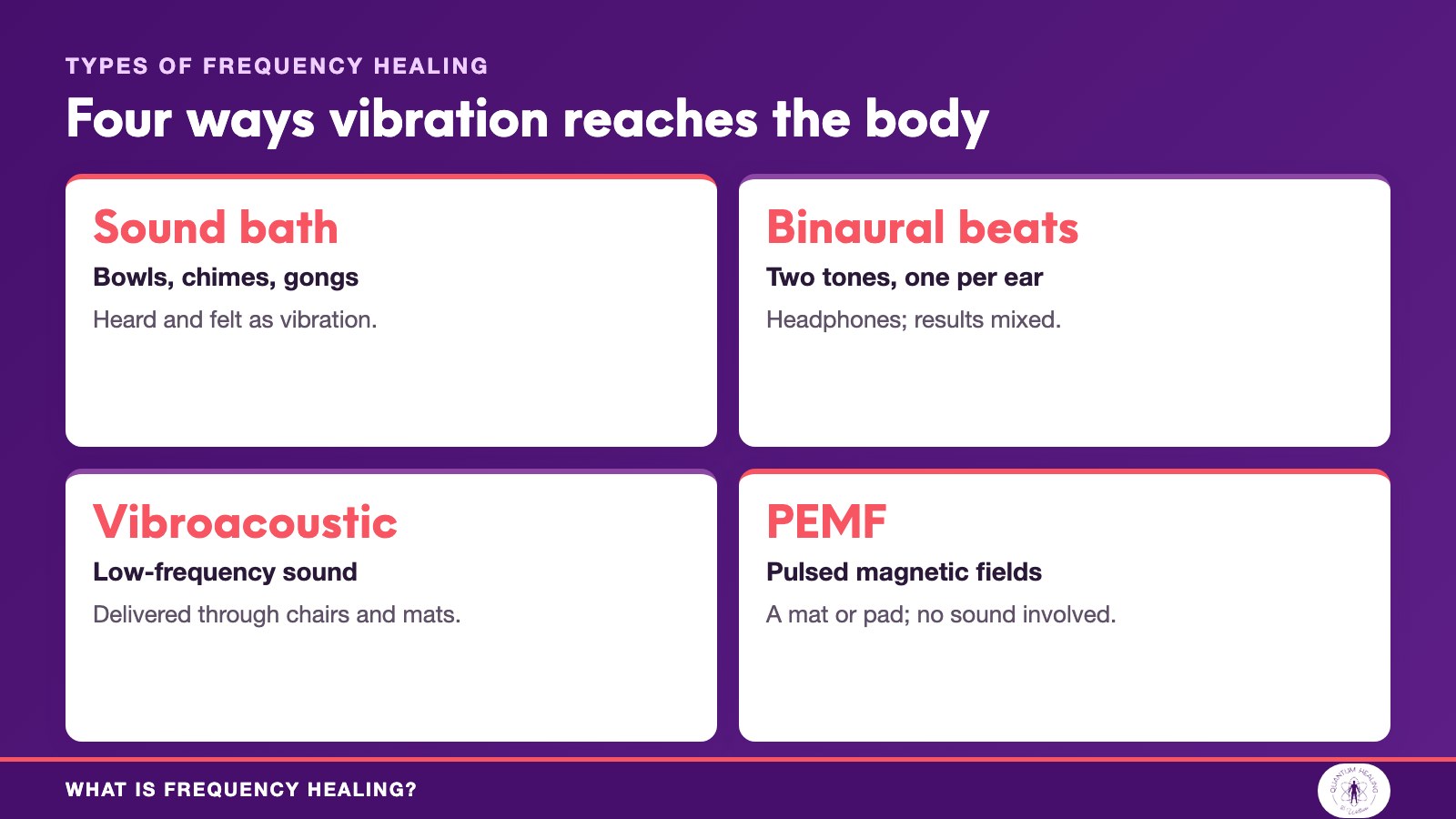
The main types of frequency healing are sound baths, tuning forks, binaural beats, and vibroacoustic therapy. Light-based sessions and pulsed electromagnetic field (PEMF) therapy are related types. Each type delivers a different kind of vibration. The table below shows what each type uses and where the evidence stands.
| Type | What it uses | Evidence status |
|---|---|---|
| Sound bath | Singing bowls, chimes, gongs | Small studies show lower tension; research is limited |
| Tuning forks | Struck forks held near the body | Practitioner method; little controlled research |
| Binaural beats | Two tones, one per ear, through headphones | Mixed results across studies |
| Vibroacoustic therapy | Low-frequency sound through chairs and mats | Early research; field still emerging |
| Light-based sessions | Red, near-infrared, or pulsed light | Studied separately from sound |
| PEMF | Pulsed magnetic fields from a mat or pad | Studied separately from sound |
Only the first four rows involve sound. The graphic below compares four of these types side by side.
What Is Sound Healing and What Happens in a Sound Bath?
Sound healing is a frequency practice in which a person listens to instruments or tones in a quiet room to relax. A sound bath is the format people picture first. UCLA Health describes it as a full-body listening experience with chimes and metal or crystal singing bowls.
Participants choose a comfortable position, sitting or lying down. Cedars-Sinai says sessions begin with breathing exercises and setting intentions. The practitioner then plays instruments to create an immersive sound environment.
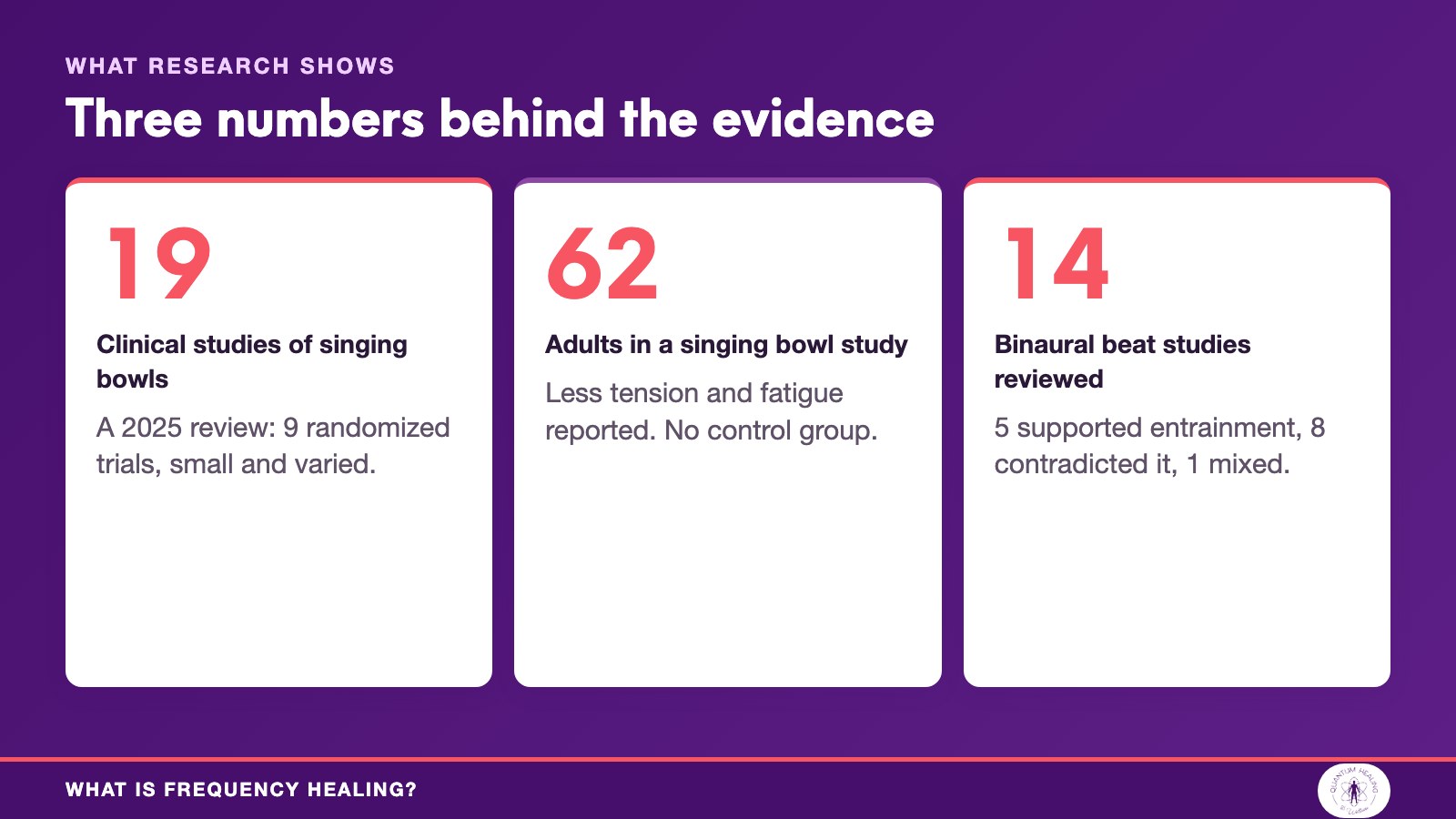
A 2017 observational study followed 62 adults after one singing bowl meditation. Participants reported less tension, anger, fatigue, and depressed mood, with all P values below .001. The study had no control group, so researchers could not separate the sound from simple rest. The next section covers a form of sound that uses headphones.
What Are Binaural Beats and Brainwave Entrainment?
Binaural beats are an auditory illusion in which two tones of slightly different frequencies play separately in each ear. The brain perceives a third pulsing tone at the difference between them. A 2023 review notes that people can hear these beats in the range of about 1 to 30 Hz.
Brainwave entrainment is the idea that the brain then oscillates at that same frequency. Wellness providers offer brainwave entrainment sessions that use this concept with guided audio.
Research on the idea is mixed. A 2023 systematic review in PLoS One covered 14 studies. Five supported brainwave entrainment, eight contradicted it, and one was mixed.
Results look better for mood and focus than for brain waves. A 2019 meta-analysis of 22 studies found an overall effect size of g = 0.45 on memory, attention, anxiety, and pain. Cedars-Sinai adds that listening is safe when the volume stays within safe levels.
What Are the Solfeggio Frequencies or "9 Healing Frequencies"?
The solfeggio frequencies are a set of nine tones from 174 Hz to 963 Hz that practitioners call healing frequencies. Practitioner lists assign each tone a purpose, such as pain relief at 174 Hz or spiritual oneness at 963 Hz. The same lists include 432 Hz and 528 Hz.
Those purposes are practitioner claims. Cedars-Sinai says healing frequencies are single tones meant to promote energy balancing, and little scientific evidence supports those claims. The practice stays popular because many people find the tones calming.
The table below places the two popular tones next to the studies that tested them.
| Study | Who took part | Finding |
|---|---|---|
| Calamassi 2019, 432 Hz vs 440 Hz music | 33 healthy volunteers, 20-minute sessions | Heart rate 4.79 bpm lower; pilot study |
| Ravikumar 2026, 528 Hz audio plus instruments | 100 adults, 60 minutes daily for 4 weeks | Lower anxiety scores and cortisol than a music control |
The next section looks at what happens when a person listens to these tones.
What Happens If You Listen to 432 Hz or 528 Hz Music?
Listening to 432 Hz or 528 Hz music produced small relaxation effects in two studies. Neither study proved that the frequency itself caused the change. Both authors asked for larger trials.
In the 2019 pilot, 33 healthy volunteers heard the same music tuned to 432 Hz and 440 Hz for 20 minutes each. Heart rate fell 4.79 beats per minute (p = 0.05) with the 432 Hz version. The authors recommended a larger randomized trial.
A 2026 randomized trial enrolled 100 adults for four weeks of 60-minute daily sessions. The sessions combined recorded 528 Hz audio with singing bowls, gongs, and bells. Anxiety scores fell 2.55 points more than in a music control group, and cortisol fell 2.54 nmol/L more.
The authors call these results preliminary. Because the sessions mixed several sounds, the study cannot credit 528 Hz alone. Light and magnetic tools raise a different question, covered next.
Is Light Therapy or PEMF Also Frequency Healing?
Light therapy and PEMF are frequency-based tools, but they use light and magnetic fields instead of sound. Practitioners group them with frequency healing because each delivers energy at a set frequency. The evidence for each is studied separately from sound research.
A PEMF mat sends pulsed magnetic fields through the body. The pulsed electromagnetic fields mat at the center is one such tool. People with implanted devices should clear any magnetic device with their physician first.
Light-based tools work through wavelengths of light. Red and near-infrared infrared light sessions are one example. Some centers also combine sound and light in a single session.
The center's acoustic light wave sessions pair specific sound frequencies with light waves and run about 60 minutes. The center describes them as relaxing and not as medical treatment. The next section walks through a typical session from start to finish.
How Does a Frequency Healing Session Work Step by Step?
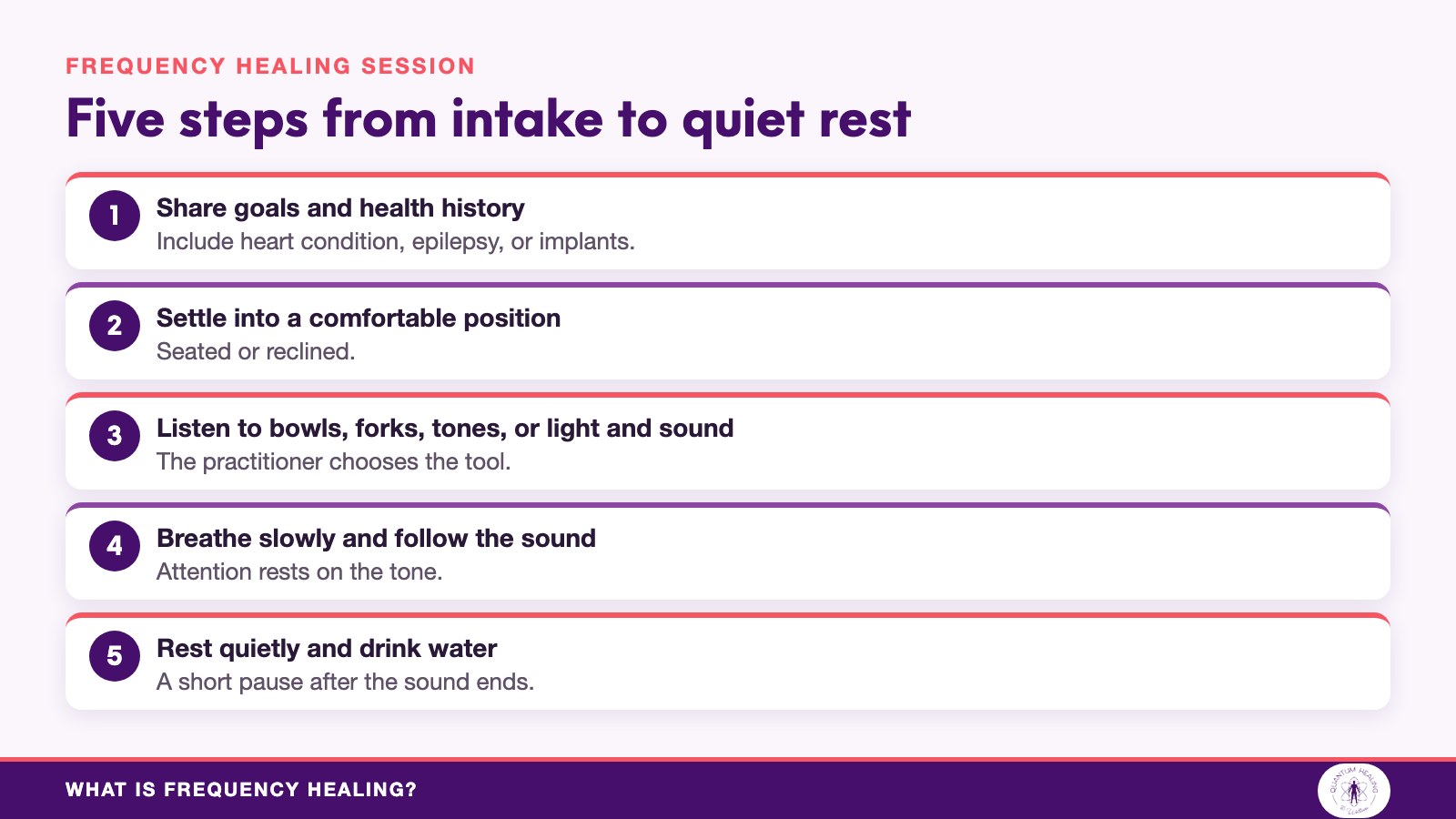
A frequency healing session follows five steps, from intake to a quiet rest at the end. The practitioner chooses the sound, light, or vibration tool after a short conversation. The numbered list shows the order.
- Share your goals and health history, including any heart condition, epilepsy, or implanted device.
- Settle into a comfortable seated or reclined position.
- Listen as the practitioner plays bowls, forks, tones, or a light-and-sound program.
- Breathe slowly and let attention follow the sound.
- Rest quietly after the sound ends and drink water.
The graphic below shows the same five steps in order.
Session length varies by tool. The center lists its acoustic light sessions at about 60 minutes. Studies used 20-minute listening sessions and 60-minute daily sessions.
Some people feel calm afterward and others notice little. Anyone can discuss expectations with the practitioner before the first visit. The next section covers what research adds to this picture.
What Does Research Show About Frequency Healing and Relaxation?
Research shows small, short-term relaxation and mood effects from sound sessions, with no proof of disease treatment. UCLA Health calls the evidence inconclusive but growing. Cedars-Sinai says studies are few, small, and mixed.
A 2025 systematic review covered 19 clinical studies of singing bowls from eight countries. Nine were randomized controlled trials, seven were case series, two were randomized crossover studies, and one was a non-randomized trial. The authors found possible benefit for anxiety, depression, and sleep but flagged small and varied studies.
Vibration studies show the same limit. UCLA Health describes a 12-week whole-body vibration program for fibromyalgia that improved pain at first. The improvements were gone three months later.
For a full look at whether the practice is real, read frequency healing evidence. The graphic below summarizes the study numbers used in this post.
Who Should Not Do Sound Healing?
People with cardiac arrhythmia, epilepsy, or implanted devices should not start sound healing without a physician's approval. UCLA Health calls sound therapy low risk but advises that conversation first. The same advice applies to pregnancy, hearing problems, and sensitivity to loud sound.
Volume matters for everyone. The National Institute on Deafness and Other Communication Disorders (NIDCD) gives a limit. Long or repeated exposure at or above 85 A-weighted decibels can cause hearing loss. Sounds at or below 70 decibels are unlikely to cause hearing loss.
Sound healing is also not a substitute for medical care. Cedars-Sinai advises people with chronic pain, anxiety, depression, or sleep disorders to discuss symptoms with a doctor. People seeking stress relief support can start with that conversation. Several related questions follow in the next section.
What Else Should You Know About Frequency Healing?
What Is Sound Frequency Healing?
Sound frequency healing is the branch of frequency healing that uses audible tones, such as bowls, forks, voice, and recordings. Sound and frequency healing differ from light or PEMF only in the type of energy used. Practitioners see all of them as ways to support relaxation. People wanting detail on energy healing benefits can start there.
Is Sound Healing Part of Reiki?
No, sound healing and Reiki are separate practices, though some practitioners combine them. One Cedars-Sinai chaplain offers sound baths alongside his Reiki training. The National Center for Complementary and Integrative Health (NCCIH) says Reiki has not been clearly shown effective for any health-related purpose. Those interested in Reiki energy sessions can ask how a practitioner blends the two.
What Is the Forbidden Frequency?
The forbidden frequency is an internet phrase, not a scientific or medical term. No agency or journal cited in this post defines one. Online posts use the phrase for claims about secret tones. Cedars-Sinai notes that sweeping claims about single healing frequencies have little scientific support.
What Are the Disadvantages of Sound Healing?
The disadvantages of sound healing are limited evidence, cost in time, and possible discomfort from loud or intense sound. Some people feel restless during long silences. Hearing damage is possible only at loud volumes, based on NIDCD guidance.
Can You Do Frequency Healing at Home?
Yes, people can listen to recorded tones, binaural beats, or a singing bowl at home. Keep the volume at a comfortable level and stop if a tone causes discomfort. Evening listening can pair with better sleep support routines such as a regular bedtime.
Frequently Asked Questions
What Do Frequencies Do to the Body?
Sound frequencies reach the body through the ears and as vibration through the skin. Studies link sound sessions to relaxation, with lower heart rate and tension in small trials. Researchers have not shown that a specific frequency repairs tissue or treats disease.
How Long Should I Listen to Healing Frequencies?
No official guideline sets a listening time. Studies used 20-minute sessions and 60-minute daily sessions for four weeks. Start with a short session at a comfortable volume and stop if anything feels uncomfortable.
How Long Does It Take for 528 Hz to Work?
No study defines a time for 528 Hz to work. The 2026 trial measured anxiety and cortisol after four weeks of daily 60-minute sessions. Results in that trial came from the combined sound program, not 528 Hz alone.
What Are the Healing Frequencies People Listen To?
People name 432 Hz, 528 Hz, and the nine solfeggio tones from 174 Hz to 963 Hz. These are practitioner traditions. Cedars-Sinai says little scientific evidence supports the claims attached to single tones.
Is There Any Truth to Sound Frequency Healing?
Yes, sound can relax the body, and small studies support short-term mood and tension effects. The stronger claims lack proof. UCLA Health calls the research inconclusive but growing.
How Does Quantum Healing & Wellness Support Frequency-Based Wellness?
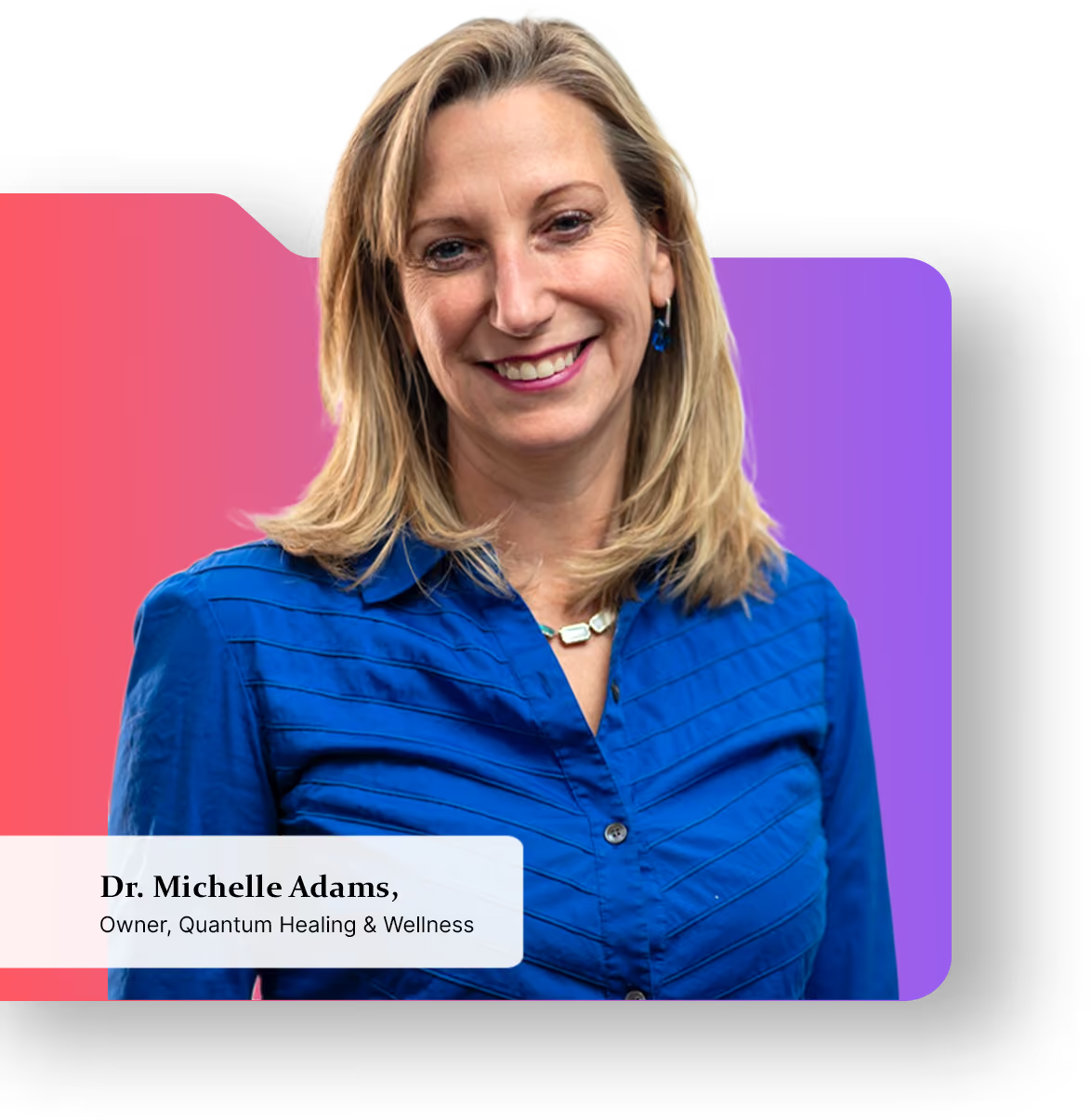
Quantum Healing & Wellness offers sound, light, and magnetic tools as relaxation support for members in Westchester. The Quantum Wellness team explains what each tool does, what research shows, and which people should check with a physician first. Dr. Michelle Adams, a Doctor of Pharmacy (PharmD), leads the center.
Anyone asking what is frequency healing can start with a conversation, since the team answers that question in plain terms. Members can also read the research page for background on the center's modalities. Frequency healing supports relaxation and does not replace medical care. Call (914) 218-3428 to ask how a session would fit your goals.
Read our recent Blogs
Quantum Healing and Wellness PMA in Westchester NY is commited to wellness conent for you