


The Emotion Code is an energy-healing method by chiropractor Dr. Bradley Nelson that uses muscle testing and a chart to find and release trapped emotions.
The Emotion Code is an alternative energy-healing method and self-help technique created by chiropractor Dr. Bradley Nelson. Practitioners use muscle testing and a chart of 60 emotions to find "trapped emotions," then release each one with a magnet. The maker states that a session releases 5 to 10 emotions in about 20 minutes. Research has not shown that trapped emotions exist.
Key Takeaways
- The Emotion Code is a self-help and energy-healing technique from Dr. Bradley Nelson, a chiropractor who graduated in 1988.
- Practitioners ask yes-or-no questions through muscle testing, narrow the answer with a chart, and release each emotion with a magnet.
- The maker reports 5 to 10 emotions released in a 20-minute session, with mild after-effects that last a day or two.
- A 2001 blinded study of a related muscle test found a kappa of 0.03. Published medical research does not yet include a controlled trial of the Emotion Code itself.
- The method is a complement to, not a replacement for, medical care or licensed mental health care.
What Is the Emotion Code and Who Created It?
The Emotion Code is an energy-healing technique that aims to find and release "trapped emotions" from the body. Dr. Bradley Nelson, a chiropractor, created the method and wrote the book The Emotion Code. His biography states that he graduated from Life Chiropractic College West in 1988 and retired from active practice in 2004.
Practitioners describe Emotion Code therapy as a way to let go of emotional baggage without long talk sessions. Supporters call it emotion code healing, though the label is not a medical term. A trained Emotion Code session follows a set routine of testing, identifying, and releasing. The routine starts with a belief about emotions, covered next.
What Are Trapped Emotions According to the Emotion Code?
Learning what is the emotion code starts with its core idea. Trapped emotions are, in this method's theory, packets of emotional energy that stay in the body after a stressful event. Practitioners say a trapped emotion can sit in a joint, the neck, or the chest. Dr. Nelson suggests some people carry one trapped emotion for every day of the year.
The theory holds that each trapped emotion comes from one event. The event can belong to the person, or the person can absorb it or inherit it. No study found has confirmed that emotions leave energy behind in tissue. The National Institute of Mental Health (NIMH) describes stress as a physical or mental response to an external cause. The next question is how practitioners claim to find these emotions.
How Does Muscle Testing Work in the Emotion Code?
Muscle testing works as a yes-or-no signal in the Emotion Code. A practitioner asks a question and judges whether an arm muscle stays strong or gives way. Practitioners say the response comes from the subconscious mind. A strong hold means yes, and a weak hold means no.
Practitioners describe the basic steps this way:
- The person raises one arm out to the side, level with the floor.
- The practitioner asks the body a yes-or-no question.
- The practitioner presses down on the arm with even pressure.
- An arm that holds against the pressure counts as yes.
- An arm that gives way counts as no.
Muscle testing comes from applied kinesiology, which Dr. George Goodheart Jr. introduced in 1964, according to one practitioner site. The Emotion Code technique uses this signal to work through a chart, as the next section shows.
What Is the Emotion Code Chart?
The Emotion Code chart is a printed list of 60 emotions that practitioners use to name a trapped emotion. Practitioners narrow the answer step by step with muscle testing, moving from a group of emotions to one named emotion. Examples on the chart include abandonment and heartache.
After a name appears, practitioners ask follow-up questions. Typical questions cover the person's age at the time, and whether the emotion was absorbed, inherited, or the person's own. The chart gives the session its structure, which leads to the session itself.
How Does an Emotion Code Session Work Step by Step?
An Emotion Code session works in a repeating cycle of five steps that clears one emotion at a time. Discover Healing, the maker, states that each emotion is identified, cleared, and confirmed before the next one starts. The cycle repeats until the body signals it has released enough for the day.
The graphic below lays out the five steps in order.
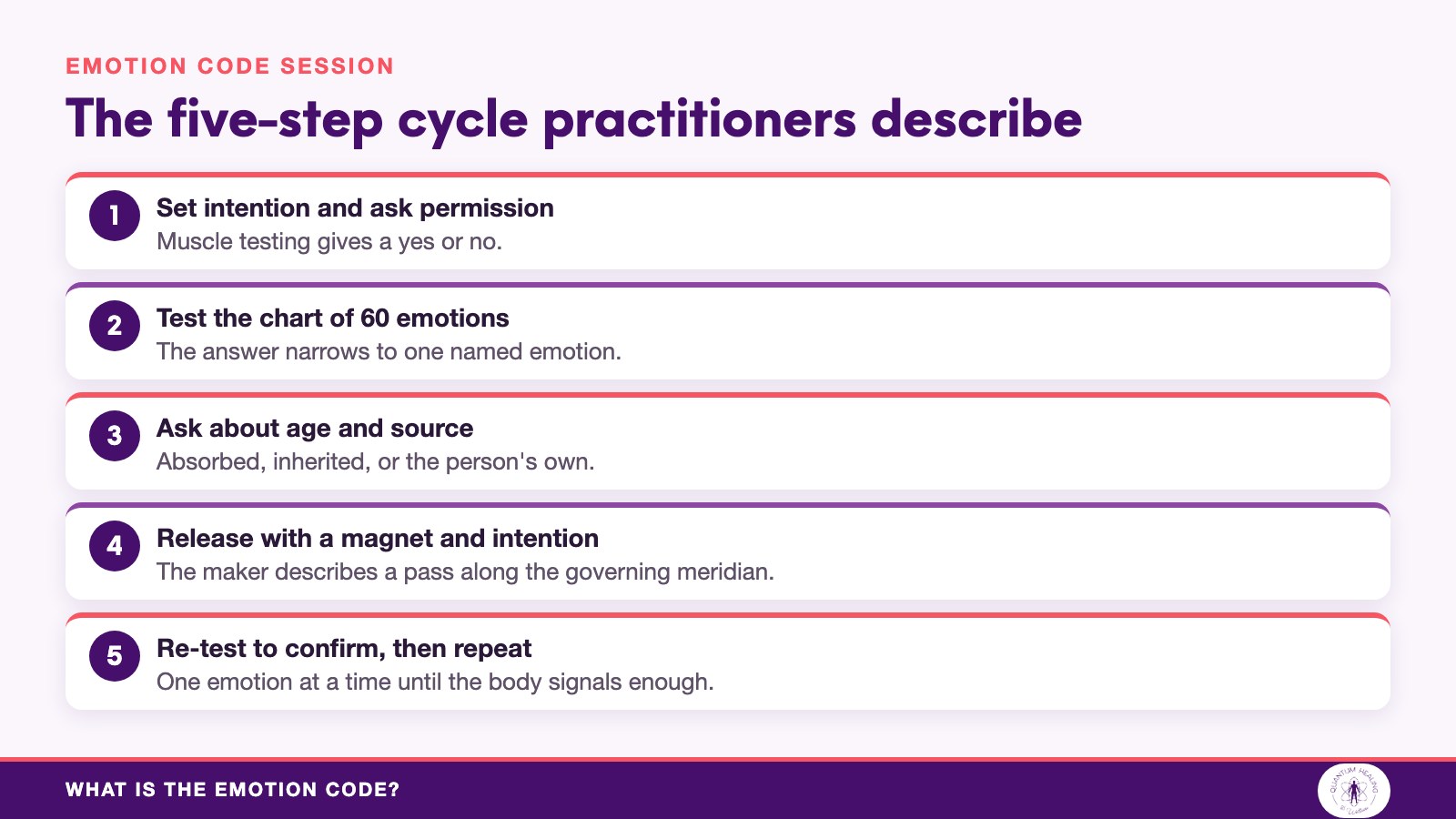
- Set an intention and ask permission through muscle testing.
- Test the chart to find a trapped emotion.
- Ask follow-up questions about the age and source.
- Release the emotion with a magnet and intention.
- Re-test to confirm the emotion is gone.
Practitioners say talking about the past is optional. Genuine Care Center, a practice that offers the method, gives an example. The event can be called simply "an event." A licensed provider can cover what a session does not. Research on emotions and health explains why feelings matter to the body.
What Does a Magnet Do in an Emotion Code Session?
A magnet serves as the release tool in the Emotion Code. The maker states that the practitioner runs the magnet along the governing meridian to "release" the emotion. The meridian is a line down the middle of the back. Discover Healing compares this to wiping a credit card with a magnet.
No study found has shown that a magnet changes emotions or stored energy. Some practitioners skip the magnet and use intention only. The trapped emotion release step is brief, and the length of a whole session comes next.
How Long Does an Emotion Code Session Take?
An Emotion Code session takes about 20 minutes in the maker's description. Discover Healing states that most sessions find and release 5 to 10 trapped emotions, and some sessions release only 2 or 3. The body sets the pace, according to the maker.
The graphic below shows the session numbers that the maker and practitioners state.

Other practitioners run shorter or longer formats. One practitioner describes virtual sessions of 15 minutes with a pendulum and a chart. Session length therefore varies by practitioner. Longer series of sessions are used for the Heart-Wall, covered next.
What Is a Heart-Wall in the Emotion Code?
A heart wall in the Emotion Code is an invisible barrier of trapped emotions. Practitioners say the subconscious builds it around the heart after a painful event. Dr. Nelson names it the Heart-Wall and estimates about 93% of people have one. That figure is the maker's estimate, not a research result.
Practitioners describe the effects as numbed emotions, difficulty giving and receiving love, and neck or shoulder tension. Triad Health Center, a practice that offers the method, says clearing a Heart-Wall takes about 2 to 5 sessions. Practitioners release it one layer at a time, using the same cycle as for other emotions.
No study found has tested the Heart-Wall. People who feel numb, isolated, or low for weeks should talk with a licensed mental health professional. The 988 Suicide and Crisis Lifeline offers support at 988. Remote sessions come up next.
Can the Emotion Code Be Done Remotely?
Yes, practitioners say the Emotion Code works remotely. Discover Healing states that it works as well from a distance as in person. Many practitioners offer remote sessions by phone or video.
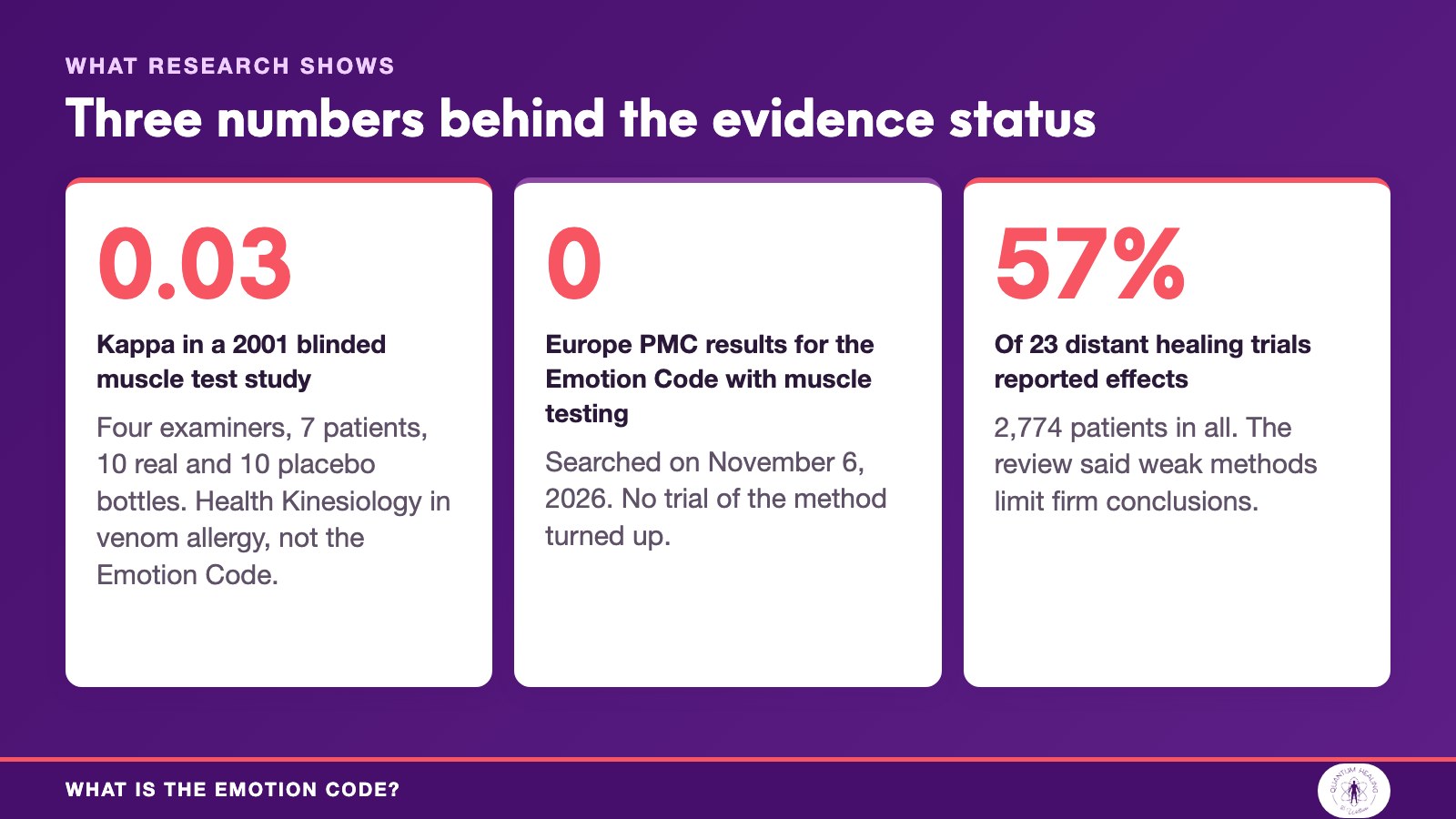
The maker explains this with quantum entanglement, an explanation that research on the method has not tested. A 2000 review in the Annals of Internal Medicine looked at distant healing. It found 23 randomized trials with 2,774 patients, and 13 of them (57%) reported significant effects. The authors said weak methods made firm conclusions difficult.
Remote sessions share the same evidence limits as in-person sessions, which leads to the main question.
Is the Emotion Code Legit?
No controlled trial of the Emotion Code has shown that it works, so its claims remain unproven. A search of Europe PMC on November 6, 2026 for the Emotion Code with muscle testing returned 0 results. Practitioners and clients report feelings of relief, but personal reports are not trial evidence.
Evidence on related parts is limited. A 2001 study in Complementary Therapies in Medicine tested a Health Kinesiology muscle test. Four examiners tested seven patients with confirmed wasp venom allergy, using 10 real and 10 placebo bottles each. The overall kappa was 0.03, and sensitivity was 40% while specificity was 60%.
The graphic below pulls the key research numbers together.
The authors concluded that the test was no more useful than random guessing. That result applies to Health Kinesiology in venom allergy and not to the Emotion Code itself. A 2007 critique by Mitchell Haas and Robert Cooperstein addressed applied kinesiology. The authors called extending muscle testing to it "risky." The table below summarizes the claims and the research status.
| Claim | Who states it | Research status |
|---|---|---|
| Emotions get trapped in the body as energy | Maker and practitioners | Not shown in studies |
| Muscle testing reveals what the subconscious knows | Maker and practitioners | One blinded test of a related method: kappa 0.03 |
| A magnet releases the emotion | Maker | Not tested in the studies found |
| Sessions work from a distance | Maker and practitioners | Distant healing trials: mixed, weak methods |
The table shows claims on the left and the research status on the right. Reports of relief may still be real as experiences. The placebo effect may explain part of that, and the next section looks at it.
Why Do Some People Feel Better After an Emotion Code Session?
Some people feel better after an Emotion Code session because of relaxation, attention, and expectation. The National Center for Complementary and Integrative Health (NCCIH) defines the placebo effect as a good outcome from expecting help. NCCIH notes that how a provider interacts with a person can bring a positive response.
NCCIH says Reiki, a related energy method, has not been clearly shown effective for any health-related purpose. The agency also says Reiki has not been shown to have harmful effects. These statements cover Reiki, not the Emotion Code, but the same research gap applies. Reading about energy healing risks helps set realistic expectations.
What Is the Difference Between Reiki and the Emotion Code?
The main difference is the tool. Reiki uses light touch or hands near the body, while the Emotion Code uses muscle testing, a chart, and a magnet. Reiki directs energy, and the Emotion Code searches for specific emotions. Both belong to energy healing and share the same evidence gap.
| Feature | Reiki | Emotion Code |
|---|---|---|
| Main tool | Light touch or hands near the body | Muscle testing and a chart |
| Goal | Support the body's own healing response | Find and release trapped emotions |
| Special item | None | Magnet |
| Founder | Based on an Eastern belief in energy | Dr. Bradley Nelson |
The table shows how the two methods differ in tools and goals. People who prefer a hands-on approach may start with Reiki practitioners. People drawn to a question-and-answer format may choose the Emotion Code. Practitioners need a clear definition, and that is the next topic.
What Is an Emotion Code Practitioner?
An Emotion Code practitioner is a person who has learned Dr. Nelson's method and applies it to clients. The title alone does not make a person a licensed mental health professional. Practitioners do not diagnose conditions, and they do not replace a doctor or a licensed therapist.
NIMH notes that most psychotherapy takes place one-on-one with a licensed mental health professional. Anyone with persistent distress should see such a professional, and the section below covers other safety points.
Who Should Talk to a Healthcare Provider First?
People with a medical or mental health condition should talk to a healthcare provider before starting the Emotion Code. The method does not diagnose or treat any condition. A provider can rule out causes of symptoms that a session cannot address.
A provider conversation matters most in these situations.
- Sadness, panic, or sleep loss that lasts for weeks.
- Chest pain, shortness of breath, or other physical symptoms.
- Thoughts of self-harm, which call for the 988 Lifeline right away.
- Pregnancy or a medical device such as a pacemaker, since magnets are involved.
- Children, who need a parent or guardian involved.
NIMH lists headaches or body pain, high blood pressure, and loss of sleep among the symptoms of stress and anxiety. Each symptom can have a medical cause, so a provider visit comes first. More background on emotional stress support is available.
What Else Should You Know About the Emotion Code?
How Do I Do the Emotion Code on Myself?
People who want to try the Emotion Code on themselves learn self muscle testing and then work through the chart. Discover Healing publishes guides on self muscle testing and on using the method on yourself. The same evidence limits apply to self sessions.
What Is the Difference Between the Emotion Code and the Body Code?
The Body Code is a later system from Dr. Nelson, which his biography says he developed in 2009. The Emotion Code focuses on trapped emotions. The Body Code covers other areas of balance, according to the maker. Readers can find more context on energy methods in a frequency healing research review.
What Are Signs the Body Is Releasing Trapped Emotions?
Practitioners describe chills, yawning, a sense of lightness, tiredness, or tearfulness after a release. Triad Health Center reports that some clients feel brief nausea or dizziness. Discover Healing states that effects rarely last more than a day or two and are usually mild. Persistent or severe symptoms need a medical check. People who want a different belief-based method can read about Spiritual Response sessions.
Do You Have to Talk About Your Past in an Emotion Code Session?
No, practitioners say talking is optional. Genuine Care Center states that the event can be called "an event" and that sharing details is a choice. Sharing may help the practitioner find related emotions, the practice says.
Can a Trapped Emotion Come Back After Release?
Practitioners say a released emotion does not return, but a similar emotion from a different event can appear. Genuine Care Center states this directly. No study found has tested the claim. Stress itself can return, as the mind-body link post explains.
Frequently Asked Questions
Is Dr. Bradley Nelson a Real Doctor?
Dr. Nelson is a chiropractor. His published biography lists a chiropractic college, Life Chiropractic College West, with graduation in 1988. The biography does not list a medical school, so he is not described as a medical doctor.
How Many Emotion Code Sessions Do People Need?
The number of sessions varies by practitioner and goal. Triad Health Center states that Heart-Wall work takes about 2 to 5 sessions. The maker states that the body decides how many emotions release in each session.
Can the Emotion Code Replace Therapy?
No, the Emotion Code does not replace therapy or medical care. NIMH states that psychotherapy mostly takes place with a licensed mental health professional. People can use the Emotion Code alongside professional care if their provider agrees.
Is the Emotion Code Safe?
NCCIH states that Reiki, a related energy method, has not been shown to have harmful effects. The maker lists mild after-effects such as tiredness or tearfulness. People with pacemakers or other implanted devices should ask a doctor before magnets are used near the body.
Does the Emotion Code Work on Children and Pets?
Some practitioners offer sessions for children and animals. No study found has tested this approach. Parents should keep pediatric care in place and ask a pediatrician about any concerns.
How Does Quantum Healing & Wellness Support Emotional Wellness?
Quantum Healing & Wellness offers the Emotion Code as one of its energy-based services in Bedford Hills, New York. Sessions are described as general wellness support, not medical treatment. Dr. Michelle Adams, a Doctor of Pharmacy with 27 years in the pharmaceutical industry, founded the center.
The center is a private membership association. Members can book an Emotion Code practitioner visit alongside Reiki or Access Bars sessions. Each service is separate, and the practitioner explains how each one differs from the others. Members decide which services fit their own goals.
Families can meet the founder and the team before booking.
People with questions about fit, safety, or membership can call (914) 218-3428. The center can explain membership, available services, and how a first visit works. Questions about the Emotion Code, other services, or scheduling are welcome. Anyone still asking what is the emotion code can speak with the team at Quantum Wellness. The team explains a first visit and when to see a doctor first.
Read our recent Blogs
Quantum Healing and Wellness PMA in Westchester NY is commited to wellness conent for you