



The Energy Enhancement System is a wellness room built from custom computers that the maker says generate scalar and biophotonic fields during sessions of about 2 hours.
The Energy Enhancement System (EESystem) is a room-sized wellness setup created by Dr. Sandra Rose Michael. Custom computers installed in sets of 4 units produce what the maker calls scalar and biophotonic fields. Guests recline in the room for about 2 hours. Peer-reviewed research on the system is absent, so its health claims remain the maker's own.
Key Takeaways
- The EESystem is a wellness room with custom computers that the maker says generate scalar waves and biophotons.
- Dr. Sandra Rose Michael created it, and the maker recommends sessions of about 2 hours.
- A Europe PMC search on 2026-11-06 found 0 peer-reviewed records for the exact phrase energy enhancement system.
- People report relaxation and calm, but these are self-reports and not trial results.
- Anyone who is pregnant, takes prescription medication, or has an implanted device should talk to a doctor first.
What Is the Energy Enhancement System?
The Energy Enhancement System (EESystem) is a wellness environment built from custom computers arranged around a seating area. The maker says the units generate scalar waves and biophotonic light. Guests recline in the room, usually for about 2 hours. Independent research on the system is absent, so this guide separates the maker's claims from what studies show.
People also call it EES therapy or an ee system. Practitioners place it in the energy wellness category and not in conventional medicine. Quantum Healing & Wellness runs a EESystem field room that follows the center layout the maker describes. Anyone asking what is the energy enhancement system should know that centers use the name for the room. The name does not describe a handheld device. The next question is who built the technology.
Who Created the Energy Enhancement System?
Dr. Sandra Rose Michael created the Energy Enhancement System. The maker's About page says she developed it over two decades and describes her field as integrative biophysics. The page also lists medical advisors and says systems operate in centers, clinics, meditation spaces, and homes.
The maker's homepage states that over 500 centers exist worldwide. These details come from the maker, and no independent body has verified them. A founder biography does not replace published trials, which a later section covers. First, the claimed mechanism needs a plain explanation.
How Does the Energy Enhancement System Work According to the Maker?
The maker says the EESystem works by creating a coherent field of scalar waves and biophotons inside the room. The maker defines scalar waves as longitudinal, non-linear fields that differ from ordinary radio waves. Biophotons are extremely weak light emissions from living cells.
The maker's technology briefing theorizes that the scalar field activates light signaling in DNA, a step it calls photonic fusion. The monitors also display colors, which adds a color therapy layer. Mechanisms like these remain theory in the maker's own framing.
Independent reviewers describe the wider field cautiously. A 2015 biofield device review in Global Advances in Health and Medicine says biophoton emission has incompletely understood mechanisms. The review adds that its clinical significance is unclear. A related white paper lists the lack of a common scientific definition as a core problem. The same paper cites missing validated mechanisms. The physical setup is the next piece.
The maker also says the field spreads beyond the computers and passes through walls. No independent measurement of that statement appears in the sources reviewed here. Physical room size and the unit count are the practical details guests can check.
What Does a 24-Unit EESystem Room Look Like?
A 24-unit EESystem room holds 24 computer monitors positioned on four towers around a central seating area. The maker says the precise alignment forms a toroidal field. Guests see colored screens and recline in chairs. The monitors are silent, and nothing attaches to the body.
The maker installs systems in multiples of 4 units, starting at a minimum of 4. Its technology briefing names a minimum room size of 10 by 10 feet or 12 by 12 feet. The table below shows the settings the maker assigns to each size.
| Units | Setting named by the maker | What the maker says |
|---|---|---|
| 4 units | Private in-home use | Smallest configuration the maker installs |
| 8 to 24 units | Professional wellness centers and clinics | Common size for center rooms |
| 48 units | Large public centers | Built for several clients at once |
Larger sizes serve more guests, but the maker's field claims apply to every size. Next comes what a visit looks like from the guest's chair.
What Happens During an EESystem Session?
An EESystem session is a quiet, passive stay in the field room with nothing to operate. Guests recline, close their eyes, and rest for the set time. Centers describe EESystem sessions as meditation, napping, or simple relaxation. Members can book EESystem visits at the center. A typical visit follows five steps.
- Arrive in loose clothing and settle in, leaving phones outside if the center asks.
- Choose a reclining chair in the room.
- Close the eyes, which the maker recommends for the full session.
- Rest, meditate, or sleep while the monitors run.
- Drink water and rest briefly after leaving the room.
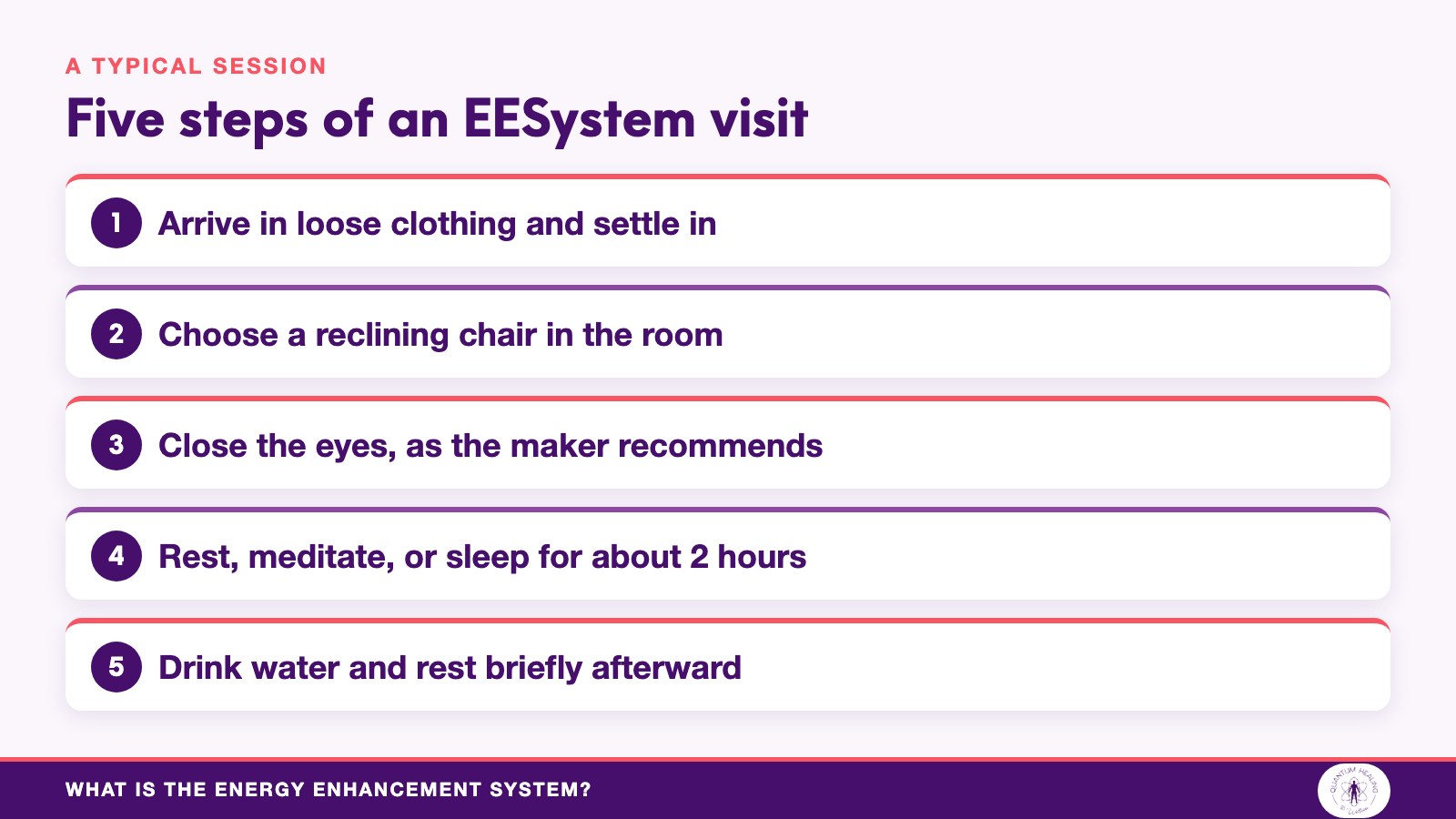
The graphic above shows the five session steps in order. One center page lists tingling, warmth, or calm as sensations some guests report. Others feel nothing distinct, which centers also state. Session length is the next detail.
How Long Is an EESystem Session?
An EESystem session lasts about 2 hours under the maker's guidance. The maker's briefing calls a two-hour session a critical threshold for the body to enter a deep state of repair. That statement is a maker claim and not a measured result.
One EESystem center lists sessions of 2 to 4 hours. Centers set their own schedules, so ask the center for the length of a visit. Time in the room matters less than the reported experience, which the next section covers.
Centers add their own wording to the maker's claims. Some pages list faster recovery, reduced discomfort, and better focus. Such lists are marketing summaries and not clinical findings.
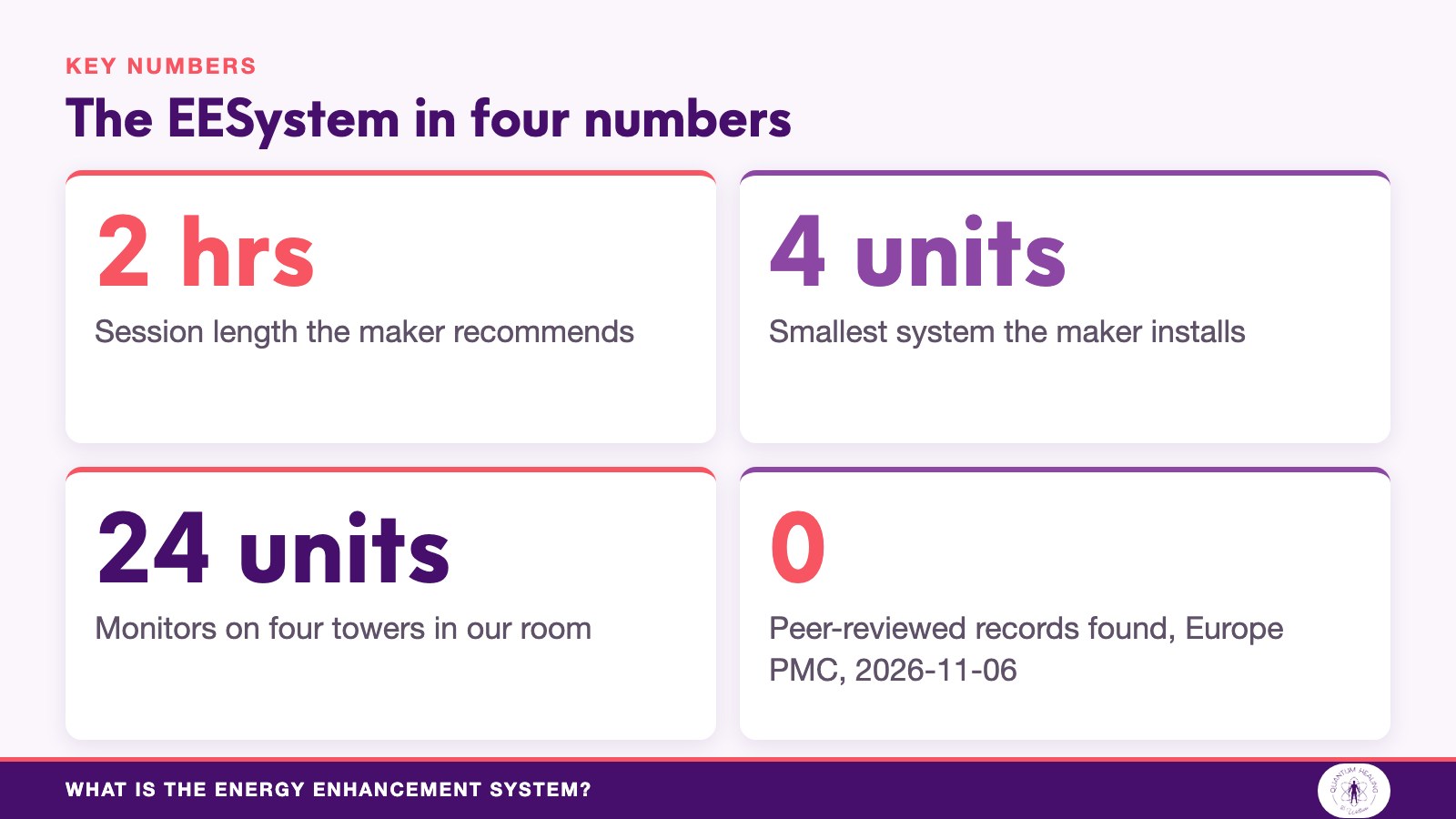
The graphic above gathers the key numbers from this guide in one place. Reported experiences follow.
What Benefits Do People Report From the Energy Enhancement System?
People report relaxation, calm, and a sense of renewed energy after EESystem sessions. The maker's About page says guests describe sessions as deeply restful, with calm, mental clarity, and overall well-being. The same page states that experiences vary by individual.
Center pages list the reported energy enhancement system benefits below. These are self-reports, not trial outcomes.
- Deeper rest and easier sleep during or after a session.
- A calmer mood and less felt stress.
- A sense of more energy and mental clarity.
- Feeling lighter in the hours after a visit.
Rest alone can produce relaxation. Readers weighing stress concerns can look at stress recovery options that carry published evidence. The evidence section explains what the research record shows.
What Does the Evidence Say About the Energy Enhancement System?
No peer-reviewed study of the Energy Enhancement System appears in Europe PMC. A search of the exact phrase on 2026-11-06 returned 0 records. A search for EESystem returned 1 record, and that paper covers flow batteries. Pages that explain what is an energy enhancement system come mostly from the maker and from centers.
The maker's own briefing says its cited evidence consists of case studies, pilot studies, and proprietary measurements. The briefing calls that a preliminary basis for inquiry rather than conclusive proof. The table compares the maker's main statements with the independent record.
| Maker statement | Source | Independent evidence found |
|---|---|---|
| A healthy cell holds 70 to 90 millivolts, and chronic illness is linked with below 50 mV | EESystem technology briefing | No peer-reviewed study of the system found |
| A 6-unit room measured 0.1 milliGauss at the center versus 0.9 mG in an average home | EESystem briefing citing a utility survey | A room reading describes the room, not a health outcome |
| Sessions leave guests restful, calm, and clear | EESystem About page | Self-reports only, with no controlled trial found |
| Scalar fields recharge cells and activate DNA light signaling | EESystem briefing | Mechanism not validated, per the biofield reviews |
Case studies and proprietary measurements have value as starting points. They cannot show cause and effect without a control group. A controlled trial compares guests in the room against guests who rest in an identical room with the system off. No such trial appears in the Europe PMC search.
The 0.1 mG figure comes from a field survey the maker cites, and the survey measures a magnetic field. A low reading does not show that a body responds. The National Center for Complementary and Integrative Health (NCCIH) addresses Reiki, a related energy practice. NCCIH says no scientific evidence supports the energy field thought to play a role in Reiki. The statement shows how reviewers treat energy field claims.
NCCIH also defines the placebo effect as a beneficial outcome from the anticipation that an intervention will help. A restful room, quiet time, and positive expectation can each shape how guests feel. Positive expectation and quiet time can feel real even when a mechanism is unproven.
A restful room also draws on the mind-body connection, where expectation and mood shape how the body feels. That link explains why rest feels real even when a mechanism is unproven.
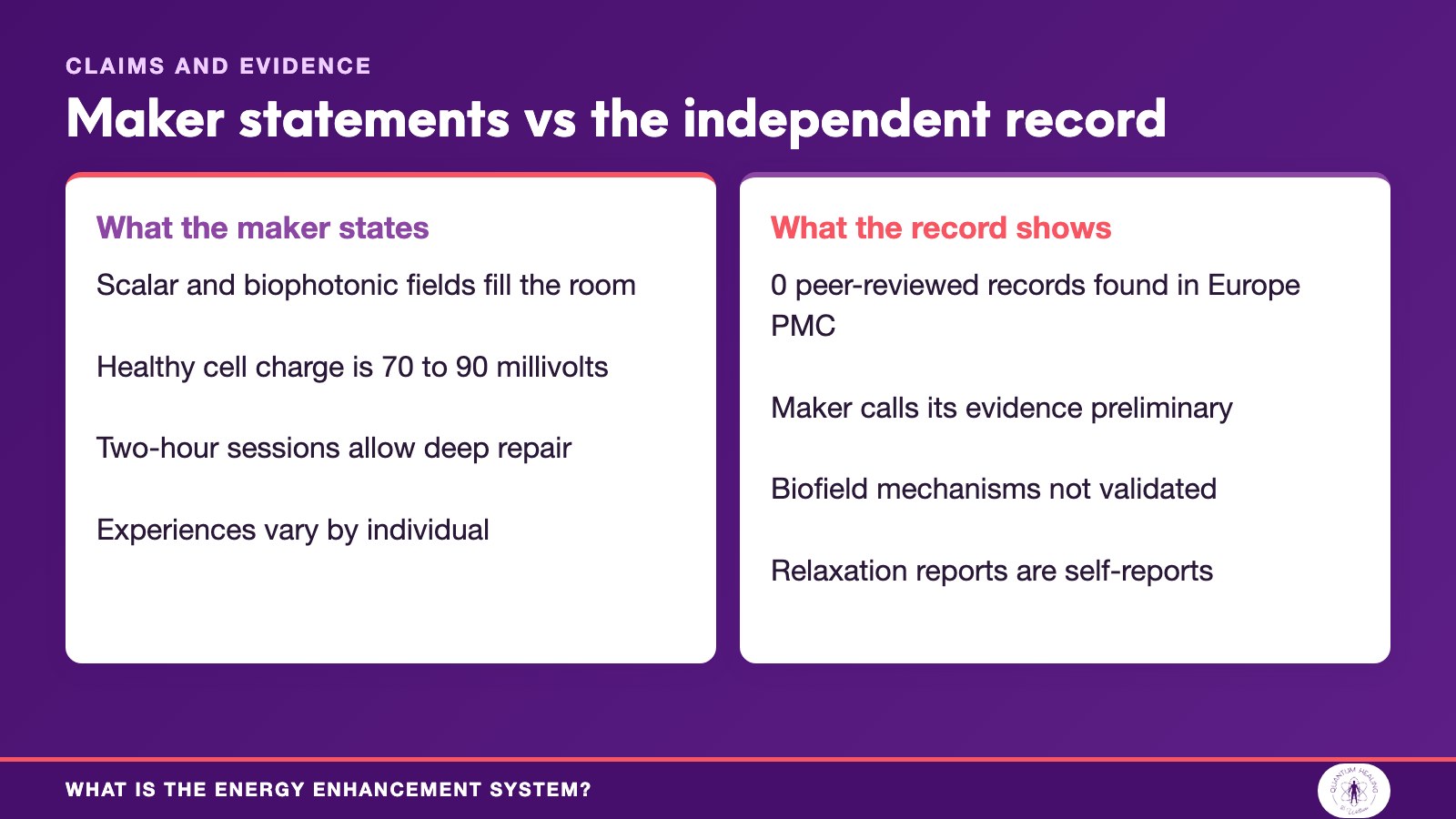
The graphic above sets the maker's statements beside the independent record. Regulation is the next factor.
Is the Energy Enhancement System FDA Approved?
No FDA record of approval or clearance for the Energy Enhancement System turned up in this review. A search of the openFDA 510(k) database on 2026-11-06 returned no device-name match for energy enhancement or EESystem. The same search also found no match in the registration and classification databases.
The maker's About page states that the system is not intended for diagnosing, treating, or preventing disease. Centers describe sessions as relaxation and wellness experiences. A database search is not a legal ruling, so the FDA is the final source on any device's status. Wider studies on wellness technologies sit on the research hub. Safety questions come next.
Who Should Talk to a Doctor Before an EESystem Session?
People who are pregnant, take medication, or have a pacemaker should talk to a doctor or healthcare provider first. Anyone managing a serious condition, including cancer, heart disease, or epilepsy, should also ask before an EESystem session. No published trial data on safety exists in Europe PMC, since 0 records came back.
No session replaces medical care, and nobody should stop or change a medication for an energy session. Readers who want a wider safety picture can review energy session safety notes. Preparation steps follow.
Guests with a history of dizziness or low blood pressure should rise slowly after a long recline. Standing up quickly after 2 hours of rest can cause lightheadedness for any reason. Staff can help with the transition. Questions about safety still belong with a healthcare provider.
How Should You Prepare for an EESystem Session?
Prepare for an EESystem session by wearing loose clothing, drinking water, and arranging an unhurried schedule. These steps keep the visit comfortable for the 2 hours or more in the room. The list below covers the basics.
- Wear loose, comfortable clothing and layers.
- Drink water before and after the visit.
- Leave phones and other electronics outside when the center asks.
- Tell the center about medications, pregnancy, or implanted devices.
- Set an intention for the session, as the maker suggests.
Some centers suggest a sea salt bath within 24 hours of a session. No study cited in this guide supports that step, so treat it as personal preference. The comparison with other energy practices follows.
How Does the EESystem Differ From Reiki and PEMF?
The EESystem differs from Reiki and PEMF mainly in delivery. It uses a room-wide field, while Reiki uses a practitioner and PEMF uses a device. The table lays out that difference. Each practice carries its own evidence record, so a comparison of delivery does not rank them.
| Practice | How it is delivered | Targeting |
|---|---|---|
| EESystem | Computers generate a field in the whole room | Room-wide, with no direct target |
| Reiki | A practitioner places hands near or on the body | Directed by the practitioner |
| PEMF | A device sends electromagnetic pulses | Aimed at the body area on the device |
A Reiki practitioner works with touch or near-touch, so the session involves a person in the room. The EESystem has no practitioner step during the session. Guests simply remain in the chair while the room runs.
The mat in PEMF mat therapy applies pulsed electromagnetic fields to a guest who lies on it. The device, not a person, delivers the pulses, and the guest stays still. Several related questions remain, and the next section answers them in short form.
What Else Should You Know About the Energy Enhancement System?
What Is EES Therapy?
EES therapy is another name for sessions in an Energy Enhancement System room. The label covers center visits and home use. Wider energy healing outcomes are described in a separate guide.
Can You Use an Energy Enhancement System at Home?
Yes, the maker installs private systems, starting at 4 units. The maker's briefing describes in-home installs as the use for 4-unit sizes. Home setups need the room space the maker lists.
Does the EESystem Measure Anything About You?
No, the EESystem does not scan or test guests. A separate service, AO Scan technology, takes a frequency-based scan instead. The two services are distinct. Each has its own purpose and session format, so confirm details before booking either one.
Does the EESystem Belong to Frequency Healing?
The EESystem sits within the wider family of frequency-based wellness practices. Claims in that family range widely, and a post on frequency healing debate weighs them. Readers can compare the evidence on each claim.
Is the EESystem the Same as Acoustic Light Wave Therapy?
No, they are different services. The EESystem uses a room field from computers, while acoustic light technology uses sound and light frequencies. Each has its own session format.
Frequently Asked Questions
How Much Does an Energy Enhancement System Cost?
Cost depends on the center or the installation, so no single figure applies. Centers set their own session terms, and the maker quotes private-use orders. Ask the center for current terms before booking.
Are There Energy Enhancement System Reviews From Independent Sources?
The energy enhancement system reviews found online are testimonials that makers and centers publish. A Europe PMC search found 0 peer-reviewed records for the system. Testimonials describe personal experience and are not controlled evidence.
What Happens During an Energy Healing Session?
A typical energy healing session has the guest rest, usually fully clothed, while a practitioner works with the guest's energy field. Techniques differ by practice. EESystem sessions replace the practitioner with a field room.
Do Energy Healers Actually Work?
Controlled research has not established that energy fields exist, according to NCCIH for Reiki. Some people still report feeling relaxed after sessions. That relaxation may reflect rest, expectation, or both.
Where Can I Find an Energy Enhancement System Near Me?
The maker's website lists a center map, and local wellness centers may offer sessions. Confirm the unit count and session length with any center before booking.
Is the EESystem the Same as an Energy Management System?
No. An energy management system is building hardware and software that monitors power use. The EESystem is a wellness room built from custom computers.
How Does Quantum Healing & Wellness Offer the EESystem?
Quantum Healing & Wellness offers a 24-unit EESystem room for members of its private membership association in Bedford Hills. The room follows the center layout described earlier, with 24 monitors on four towers. Guests recline and rest for the session. Details about the EESystem room and membership are on the service page.
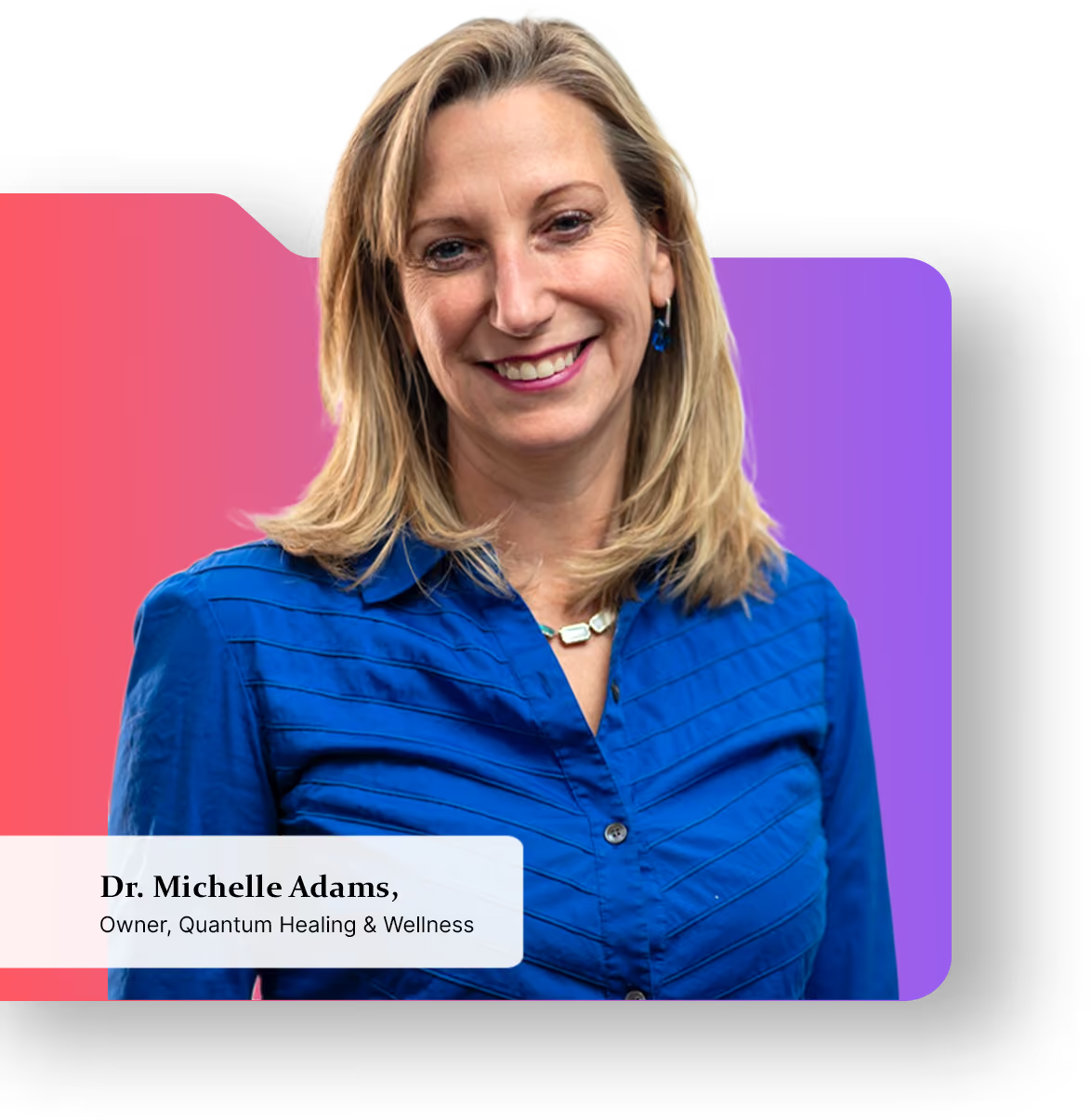
Dr. Michelle Adams, a Doctor of Pharmacy (PharmD) with 27 years in the pharmaceutical industry, founded the practice. That background shapes how we describe energy technologies: we state what the maker says and what research shows. The guide answers what is the energy enhancement system in the maker's terms and then adds the independent record. We frame sessions as relaxation and wellness experiences.
Members who want a session can call (914) 218-3428. The team answers questions about session length, preparation, and who should check with a doctor first. Our Quantum Healing practice offers sessions in addition to many related services.
Read our recent Blogs
Quantum Healing and Wellness PMA in Westchester NY is commited to wellness conent for you