


.avif)



You can reduce stress naturally through slow breathing with a long exhale, 20 to 30 minutes outdoors, 30 minutes of daily movement, meditation, bodywork and heat, and food and sleep habits that keep cortisol from staying high. Which of those you reach for depends on whether you are dealing with a spike or a load. A spike is the surge you feel right now, and it responds to a physical interrupt within minutes. A load is months of accumulated pressure, and it only comes down through repetition over weeks. Below we cover both, starting with what your body is actually doing when stress hits.
How Do You Reduce Stress Naturally?
You reduce stress naturally by combining fast physical interrupts like slow breathing and movement with daily habits like time outdoors, meditation, bodywork, better food, and enough sleep. Combining the two is the part most advice skips. Fast interrupts end a stress response that is already running. Daily habits lower the baseline the next response starts from, and neither one does the other's job.
Most Americans need both. The American Psychological Association's Stress in America survey found that 76 percent of adults name the country's future as a significant source of stress and 69 percent of employed adults say the same about work, while Gallup's Global Emotions report found that 48 percent of US adults felt a lot of stress the previous day. Roughly a quarter of adults now rate their average stress at 8 or higher on a 10-point scale, up from 19 percent in 2019. People who come to us about stress management almost never have a single trigger. They have a load.
The table below sorts the methods by what each one does in the body and how fast it works, drawing on measurements published in Frontiers in Psychology, JAMA Internal Medicine, the Indian Journal of Psychological Medicine, and research from Brown University Health and the American Heart Association.
MethodWhat It Does in the BodyHow Fast It WorksBest ForSlow breathingActivates the vagus nerve, slows heart rate, raises heart rate variability1 to 3 minutesA spikeBrisk walk or movementBurns off circulating adrenaline and releases endorphins5 to 20 minutesBothCold water on wrists and faceTriggers a reflex that drops heart rateUnder 1 minuteA spikeTime outdoorsMeasurably lowers salivary cortisol20 to 30 minutesBothMusicShifts attention and slows breathing rate on its ownMinutesA spikeMeditationChanges how threatening a situation registers in the first placeWeeks of practiceA loadMassage and bodyworkLowers cortisol and raises serotonin and dopamineSame session, deepens over weeksA loadHeat therapyShifts the body toward parasympathetic activity10 to 20 minutesBothSleepResets the hormonal system that governs stress chemistryNightly, cumulativeA loadFood choicesSupplies magnesium, fiber, and omega-3s that buffer cortisolWeeksA loadTalking to someoneReduces the sense of facing a problem aloneSame conversationBothJournalingMoves looping thoughts out of working memory5 to 10 minutesBoth
Every method in that table works on the same underlying chain of events. Knowing the chain is what tells you which column you need.
What Happens in Your Body When You Get Stressed?
When you get stressed, your brain triggers two systems in sequence: a fast nerve signal that releases adrenaline within seconds, and a slower hormonal pathway that releases cortisol over several minutes. Adrenaline arriving within seconds is why a stressful email changes your heart rate before you finish reading it.
Heart rate is only part of what adrenaline changes. It widens the airways, pulls blood toward large muscles, sharpens attention, and tightens the muscles across your shoulders and jaw. All of that is useful for a physical threat and almost entirely useless for a deadline, which is the mismatch at the center of modern stress.
Cortisol arrives behind it through the hypothalamic-pituitary-adrenal axis, usually called the HPA axis. The HPA axis keeps blood sugar available and the body mobilized for as long as the brain believes a threat is present. Short bursts of cortisol are healthy. The problem is sustained release, because a system designed to run for minutes ends up running for months, and the physical symptoms people report are usually that system staying on.
Staying on for months also changes which word applies to what you are feeling, and the two words most people use interchangeably are not the same thing.
What Is the Difference Between Stress and Anxiety?
The difference between stress and anxiety is the trigger: stress is a response to something identifiable happening outside you, and it fades when that thing resolves, while anxiety persists even after the trigger is gone or without any clear trigger at all. A clear trigger is the test. If you can name the thing and the feeling eases when the thing ends, that is stress.
Stress ending with its trigger is what makes the methods in this article work. They act on an active stress response or on the load behind it. Anxiety that continues with no identifiable cause, or that persists for months after a situation has resolved, works differently and usually responds best to structured treatment with a licensed professional.
The two also overlap constantly, since sustained stress is one of the most common doorways into anxiety. If you are not sure which one you are dealing with, it is worth asking a doctor or therapist rather than guessing.
What Relieves Stress Quickly?
Slow breathing with a long exhale relieves stress quickest, because it is the only voluntary action that directly switches the nervous system out of its alert state. Switching out of the alert state is what you need in the first few minutes, and almost nothing else on the list does it that fast.
Speed matters here because of what an adrenaline surge is. Adrenaline is a physical event with a physical half-life, so talking yourself out of it rarely works while it is running. A physical interrupt works because it speaks the same language the stress response is written in.
Interrupts are not a cure for anything. They end the current surge and buy you a clearer head, which is often exactly what the moment requires.
How Does Deep Breathing Reduce Stress?
Deep breathing reduces stress by activating the vagus nerve, which carries the parasympathetic signal that slows heart rate, lowers blood pressure, and ends the alert state. The alert state ends fastest when your exhale is longer than your inhale, because heart rate naturally rises on the in-breath and falls on the out-breath.
Out-breath length is the active ingredient, and most advice to "breathe deeply" misses it entirely. Breathing at about six breaths per minute, roughly five seconds in and five seconds out, produces the strongest effect in measured studies. At that pace, heart rate variability and baroreflex sensitivity both rise, which are the standard physiological markers of a body shifting into recovery mode.
Six breaths per minute is also taken seriously outside of wellness circles. Device-guided slow breathing in that range is cleared by the Food and Drug Administration for relaxation, and the American Heart Association recognizes it as an adjunctive approach for blood pressure. A version anyone can do without a device is to inhale for four counts and exhale for six, repeated ten times.
What Else Works in Under Five Minutes?
The fastest non-breathing options are cold water, a brisk walk, music, stretching, stepping outside, and writing the thought down. Writing the thought down works for a different reason than the others, which act on the body directly.
These are the interrupts worth keeping within reach:
- Cold water on your wrists and face: major blood vessels sit close to the skin there, and cooling them triggers a reflex that drops heart rate within seconds
- A brisk five-minute walk: burns circulating adrenaline instead of letting it sit
- Calming music: slows your breathing rate without you having to think about it
- A shoulder and neck stretch: releases the exact muscles adrenaline just tightened
- Stepping outside: daylight and open space both lower physiological arousal
- Writing it down: moves a looping thought out of working memory so your brain stops rehearsing it
- A hand or foot massage: pressure on those areas registers as safety signals and eases tension further up the chain
- Counting backward from twenty: occupies the part of the mind that is busy catastrophizing
Walking appears on that list for a reason that goes well beyond five minutes, and it is worth looking at on its own.
Does Exercise Reduce Stress?
Yes, exercise reduces stress, and it is the most reliable way to clear the stress chemistry your body has already produced. Already-produced chemistry is the piece that breathing alone does not fully handle, because adrenaline and cortisol are released into the bloodstream and have to go somewhere.
Movement is where they go. The stress response evolved to fuel physical action, so giving it physical action completes the loop it was designed for. Exercise also lowers cortisol over time, improves mood through endorphin release, and anchors the daily rhythm that keeps the whole hormonal system steady.
The effect shows up in sleep as well, which matters because poor sleep and high stress feed each other. We see that loop constantly: a stressful month produces short nights, and short nights raise next-day cortisol, which makes the following month feel worse than it is.
What Kind of Exercise Is Best for Stress?
Moderate aerobic activity for about 30 minutes most days is best for stress, and the kind you will actually keep doing beats the kind that looks best on paper. Keeping it up is the whole game, since stress reduction from exercise is cumulative rather than achieved in a single hard session.
Single hard sessions can even work against you. Intense training is itself a physical stressor that raises cortisol in the short term, which is fine for a body that is otherwise recovering well and counterproductive for someone already running on empty. Walking, swimming, cycling, dancing, gardening, and yoga all qualify.
Yoga and tai chi add a second mechanism on top of the movement, since both pace the breath deliberately. Doing any of this outdoors adds a third, and the outdoor piece has a measured dose behind it.
How Much Time in Nature Reduces Stress?
Twenty to thirty minutes outdoors produces the largest drop in cortisol per minute spent, and anything past that keeps helping at a slower rate. That window comes from a study published in Frontiers in Psychology by researchers at the University of Michigan, who measured salivary cortisol before and after outdoor time in ordinary daily life rather than in a lab.
Ordinary daily life is what makes the finding useful. Over eight weeks, participants took an outdoor break of at least ten minutes, three or more times a week, choosing their own time and place. The outdoor experience produced a 21.3 percent per hour drop in cortisol beyond the hormone's normal daily decline of 11.7 percent, with the greatest efficiency between 20 and 30 minutes.
Efficiency between 20 and 30 minutes gives you a concrete target rather than vague advice to get fresh air. The researchers also held participants to two conditions that are easy to overlook: no phone and no conversation. A walk spent scrolling is not the intervention that was measured.
Nothing on the list so far changes the thing that started the stress response. That requires working further upstream.
How Does Meditation Reduce Stress?
Meditation reduces stress by changing how threatening a situation registers before your body commits to a full stress response. Committing to the response is a decision your brain makes in the first second, and meditation trains the gap between the event and that decision.
That gap is where the benefit lives, and the research supports it without overselling it. A meta-analysis published in JAMA Internal Medicine pooled 47 randomized trials covering 3,320 participants and found that mindfulness meditation produced moderate improvement in anxiety, with an effect size of 0.38 at eight weeks, and in depression at 0.30. Those are real effects and they are modest ones, which is worth saying plainly.
Plain expectations help people stick with it. Ten minutes daily is enough to begin, and consistency does more than duration. Guided audio tends to work better than silent practice for beginners, and BrainTap sessions pair guided meditation with light and sound patterns that guide brain activity toward slower, calmer states.
What Are the Best Foods to Reduce Stress?
The best foods to reduce stress are avocados, beans and lentils, fatty fish, fermented foods, leafy greens, nuts, and vitamin C rich fruits, because each supplies nutrients that help regulate cortisol. Regulating cortisol through food is slower than any other method here, and it works on the baseline rather than the moment.
Brown University Health identifies the specific mechanisms. Avocados carry both magnesium and fiber, two nutrients tied to lower cortisol. Omega-3 fatty acids from salmon, sardines, chia, flax, and walnuts help protect the body against cortisol surges. Fermented foods such as sauerkraut, kimchi, and kombucha support gut health, which research links to reduced anxiety. Vitamin C deficiency is associated with a higher risk of stress-related disease, which puts citrus and strawberries on the list.
Three things work against you in the same window. Caffeine amplifies the jittery, on-edge feeling and disrupts sleep. Alcohol feels relaxing and then lowers serotonin and degrades sleep quality. Sugar and artificial sweeteners have both been linked to higher risk of depression. Sorting out which of these is doing the most damage in a given week is usually the first conversation in nutritional counseling.
Does Ashwagandha Reduce Stress?
Ashwagandha reduces stress in studied populations, and it has more placebo-controlled evidence behind it than most herbs marketed for calm. The most cited evidence is a randomized, double-blind, placebo-controlled trial published in the Indian Journal of Psychological Medicine, which gave 64 chronically stressed adults 600 milligrams of ashwagandha root extract daily for 60 days.
Sixty days produced a 27.9 percent reduction in serum cortisol and a 44 percent reduction on the Perceived Stress Scale compared with placebo. Magnesium and L-theanine are the other two that come up most often, the first for muscle tension and nervous system calm, the second for mental overdrive without sedation.
We do not sell or recommend supplements, and the figures above describe what researchers measured rather than what anyone should take. Dietary supplements are not reviewed by the Food and Drug Administration for safety, effectiveness, or label accuracy before sale, and ashwagandha in particular is not appropriate for people who are pregnant, people with thyroid conditions, or people on certain medications. We cover this ground in more detail alongside natural sleep remedies, where the same cautions apply.
How Does Sleep Affect Your Stress Levels?
Sleep affects your stress levels more than any other daily habit, because the hormonal system that produces cortisol resets overnight and a short night leaves it running high into the next day. Running high into the next day is what makes a difficult week compound: you wake up already partway into a stress response before anything has happened.
Nothing has to happen for the cycle to continue, either. Stress delays sleep onset and fragments the second half of the night, and the resulting short sleep raises stress reactivity the following day. Most people trying to manage stress without addressing sleep are working against a system that is quietly resetting their baseline upward every night.
Seven hours is the floor for adults, and the fastest lever on getting there is a fixed wake time with morning daylight. We cover the full set of sleep habits separately, because it is a topic in its own right rather than a footnote to this one.
What Body Parts Hold the Most Stress?
The body parts that hold the most stress are the jaw, the neck and shoulders, the diaphragm, the hips, and the gut. The gut belongs on that list for a different reason than the others, which are all muscles that adrenaline tightens and then never gets a signal to release.
Never getting the release signal is the whole mechanism. A stress response braces the body for action, and when the action never comes, the bracing simply stays. Held long enough it stops feeling like tension at all and starts feeling like your normal posture, which is why so many people only notice it when someone presses on their shoulders.
Here is where each one shows up. The jaw clenches, often at night, producing morning headaches. The neck and shoulders ride up toward the ears. The diaphragm tightens, which shallows your breathing and feeds the stress response right back. The hips hold tension from the flight reflex. The gut responds to the brain through a direct nerve pathway, which is why stress produces stomach symptoms so reliably. Persistent muscle tension in these areas is one of the most common things members bring to us, usually described as a physical problem rather than a stress problem.
Treating it as a physical problem is not wrong. It is physical, and physical approaches work on it directly.
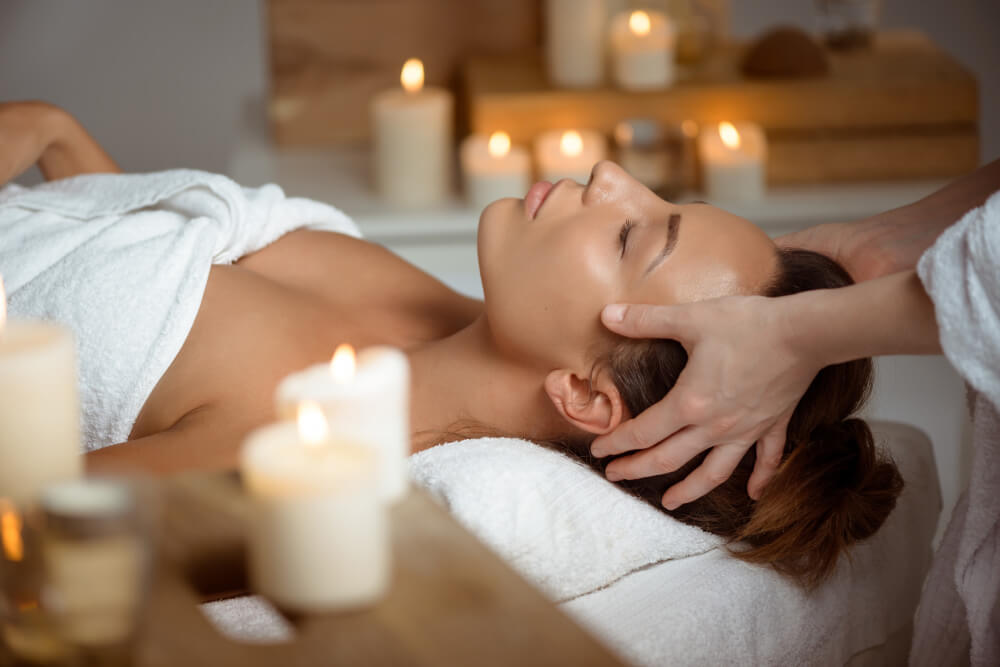
How Does Massage Reduce Stress?
Massage reduces stress by lowering cortisol while raising serotonin and dopamine, which is a measurable hormonal shift rather than just a pleasant hour. That hormonal shift has been documented repeatedly in massage therapy research, including work by Tiffany Field and colleagues showing cortisol decreasing and both mood-related neurotransmitters increasing after sessions.
Sessions work on the holding pattern described above. Sustained muscle tension keeps sending the brain feedback that something is wrong, and releasing the tension interrupts that feedback. The effect compounds with regularity, which is why a standing appointment does more than an occasional one.
Regular massage therapy also tends to surface tension people did not know they were carrying, particularly through the jaw and upper back.
Does Heat Therapy Reduce Stress?
Yes, heat therapy reduces stress by relaxing muscle tissue and shifting the nervous system toward parasympathetic activity. Parasympathetic activity is the same recovery state slow breathing produces, reached through temperature instead of through the breath.
Temperature also carries measurable downstream effects. Research from the University of Texas at Austin found that warm water between 104 and 109 degrees Fahrenheit, for as little as 10 minutes, improved sleep quality and shortened the time it takes to fall asleep, which closes the loop back to the sleep and stress cycle.
Dry heat follows the same path, and an infrared sauna session adds the practical advantage of a protected block of time with no phone in it. Fifteen to twenty minutes is a reasonable session for most people, and hydration before and after matters.
How Do You Reset Your Nervous System?
You reset your nervous system by giving it repeated, uninterrupted experiences of being safe, which the body registers through breath, touch, temperature, sound, and stillness rather than through reasoning. Reasoning is the part that does not work, which is why telling yourself to calm down has never once calmed anyone down.
What does work is repetition. A single relaxing hour feels good and changes little. The same hour weekly, supported by a short daily practice, gradually lowers the baseline your stress responses start from. Here is a ten-minute daily sequence that covers the main inputs:
- Minutes 1 to 3: breathe at six breaths per minute, inhaling for four counts and exhaling for six.
- Minute 4: unclench your jaw, drop your shoulders, and let your tongue rest flat in your mouth.
- Minutes 5 and 6: roll your shoulders and stretch your neck slowly in each direction.
- Minutes 7 and 8: sit still with your eyes closed and let your attention rest on your breath without steering it.
- Minute 9: write down anything your mind keeps returning to, without solving it.
- Minute 10: stand up, step outside if you can, and take ten more slow breaths in daylight.
Hands-on energy work aims at the same target from a different angle. Reiki sessions are built around moving the body out of its alert state and holding it there long enough for the nervous system to register the change, and the people who benefit most are usually the ones who find stillness hardest on their own.
What Are the Warning Signs of Stress?
The warning signs of stress fall into three groups: physical signs like headaches and muscle tension, emotional signs like irritability and feeling overwhelmed, and behavioral signs like disrupted sleep, appetite changes, and withdrawing from people. Withdrawing from people is the one most often missed, because it tends to feel like a preference rather than a symptom.
Missing the signs is common for a straightforward reason: they arrive gradually, and a baseline that rises slowly starts to feel normal. The American Psychological Association found that at least two thirds of Americans say their stress shows up as physical symptoms, most commonly nervous or anxious feelings, fatigue, and headaches. Among adults reporting high levels of loneliness, 94 percent reported at least one physical symptom of stress.
Catching the pattern early is the entire point of knowing the signs, and it is far easier to lower a rising load than a maxed-out one. This is the stage where emotional wellness support does the most good, well before anyone would call it a crisis.
What Are the Physical Symptoms of Stress?
The physical symptoms of stress are headaches, tight shoulders and neck, jaw pain, fatigue, stomach upset, a racing heart, shallow breathing, disrupted sleep, and appetite changes in either direction. Appetite moving in either direction catches people out, since stress reliably produces strong cravings in some people and no hunger cues at all in others.
Each of these traces back to the two systems described earlier. Adrenaline tightens muscles and quickens the heart. Cortisol affects blood sugar, appetite, and sleep architecture. The gut-brain nerve pathway explains the stomach symptoms directly.
Any of these can also have causes that have nothing to do with stress, which is why persistent physical symptoms are worth having checked by a doctor rather than attributed to stress by default.
What Happens If You Are Stressed for Too Long?
If you are stressed for too long, a system built for short bursts stays switched on, and the ongoing effects show up as poor sleep, lowered immune function, digestive trouble, persistent muscle pain, difficulty concentrating, and a flatter mood. A flatter mood is often the clearest marker, because the things that normally lift you stop working as well.
Long-term activation also has well-documented links to cardiovascular and metabolic health, which is why chronic stress is treated as a medical concern rather than a personal failing. None of that is a reason for alarm about any particular week. It is a reason to take a sustained load seriously rather than waiting it out.
If stress has been constant for months and the methods in this article are not touching it, that is useful information rather than a sign you are doing it wrong. Speak with a doctor or a licensed therapist, who can look at what else might be driving it.
How Long Does It Take the Body to Recover From Stress?
The body recovers from a single stressful event in about 20 to 60 minutes once the trigger passes, while recovering from months of accumulated stress takes weeks to a few months of consistent daily practice. Months of accumulation is where people lose patience, because the first two weeks of doing everything right can feel like nothing is changing.
Nothing changing is not what is actually happening. Heart rate and breathing settle within minutes of a stressful event ending. Cortisol takes longer to clear, usually under an hour. What takes weeks is the baseline, meaning the resting level your system returns to, which only moves through repetition. That slow baseline shift is the real goal of stress and emotional wellness work, and it is also why consistency beats intensity every time.
Repetition is easier with structure than with willpower, which is the main argument for scheduling recovery rather than hoping for it. Sessions at our Bedford Hills center give people a protected block where nothing is asked of them, and members across Westchester County tell us the regularity matters more than any single modality.
Time in the EESystem, on the PEMF mats, or in the salt room works the same way the daily ten-minute routine does, just at greater depth and on a schedule you are more likely to keep.
What Should You Do If You Can't Handle Stress Anymore?
If you can't handle stress anymore, the most useful next step is to tell one person and to speak with a doctor or licensed therapist, because reaching that point usually means the load is larger than self-management tools are built for. Being larger than the tools is not a failure of effort. Breathing exercises and walks are designed for ordinary pressure, and some situations are well past ordinary.
Telling one person comes first for a practical reason. The APA found that 69 percent of adults said they needed more emotional support in the past year, up from 65 percent the year before, which means the feeling of carrying something alone is close to universal and almost never accurate. A friend, a family member, or a colleague is enough to start.
A professional is the next step, and it is worth taking sooner than most people take it. A doctor can rule out physical causes that mimic or worsen stress, including thyroid and hormonal issues. A licensed therapist can work on the specific situation rather than on stress in general, which is what makes the difference when the pressure has a particular shape.
In the meantime, lower the bar on everything else. Keep the sleep, keep some movement, keep one person informed, and let the rest go until things steady.
Frequently Asked Questions
What Are the Main Causes of Stress?
The main causes of stress are work, money, health, relationships, caregiving, and broader uncertainty about the future. The American Psychological Association found that 69 percent of employed adults name work as a significant source of stress and 76 percent say the same about the country's future, while the Occupational Safety and Health Administration reports that 83 percent of US workers experience work-related stress. Feeling that a situation is outside your control is what turns any of these from pressure into stress.
Can You Live a Stress-Free Life?
No, you cannot live a stress-free life, and a completely stress-free life would not be a healthy goal anyway. Short bursts of stress sharpen focus, drive performance, and help you respond to genuine problems. The realistic goal is recovery: returning to baseline quickly after the stressor passes rather than staying switched on indefinitely.
What Are Signs Your Body Is Shutting Down From Stress?
People usually mean exhaustion and burnout when they ask this, and the signs are deep fatigue that sleep does not fix, difficulty concentrating, getting sick more often, losing interest in things you normally enjoy, and feeling emotionally flat. These are signals that the load has outlasted your recovery capacity, not signs of organ failure. Symptoms at this level deserve a conversation with a doctor, who can check for physical causes and help you build a plan.
Does Caffeine Make Stress Worse?
Yes, caffeine makes stress worse by raising heart rate and alertness through the same pathways adrenaline uses, which amplifies the jittery, on-edge feeling. It also disrupts sleep for far longer than most people expect, and short sleep raises next-day stress reactivity. Cutting your last cup to at least six hours before bed addresses both effects at once.
Can Stress Cause Physical Illness?
Yes, stress can contribute to physical illness, because sustained cortisol affects immune function, blood pressure, blood sugar, digestion, and sleep. At least two thirds of Americans report that their stress produces physical symptoms, according to the American Psychological Association. Stress is rarely the sole cause of a condition, but it frequently worsens one that already exists.
How Do You Calm Down in 60 Seconds?
To calm down in 60 seconds, run cold water over your wrists and splash your face, then take six slow breaths with the exhale twice as long as the inhale. Cold water on those areas triggers a reflex that lowers heart rate within seconds, and the long exhale activates the vagus nerve. One minute will not resolve the situation, but it will give you a clearer head to deal with it.
Does Journaling Actually Reduce Stress?
Yes, journaling reduces stress by moving looping thoughts out of working memory and onto paper, which stops your brain from rehearsing them. Writing down what is worrying you before bed is particularly effective, since unresolved thoughts are a common reason people lie awake. Five minutes is enough, and the goal is getting it out rather than solving it.
The Bottom Line
Reducing stress naturally comes down to matching the tool to the situation. A spike needs a physical interrupt: slow breathing with a long exhale, cold water, a short walk. A load needs repetition: 20 to 30 minutes outdoors, 30 minutes of movement most days, meditation, bodywork and heat, food that supports rather than spikes you, and at least seven hours of sleep. Expect minutes for the first kind and weeks for the second.
Start with breathing and sleep, since those two change the most for the least effort, then add one daily habit at a time. If the pressure has been constant for months and none of it is landing, that is worth taking to a doctor or a licensed therapist rather than pushing through alone. For the everyday work of keeping a nervous system out of permanent alert, that is what we do with members at Quantum Healing & Wellness.
We are always glad to talk through what might fit your situation, so get in touch whenever you are ready, or call us at (914) 218-3428.
Read our recent Blogs
Quantum Healing and Wellness PMA in Westchester NY is commited to wellness conent for you






.avif)
.png)
.png)